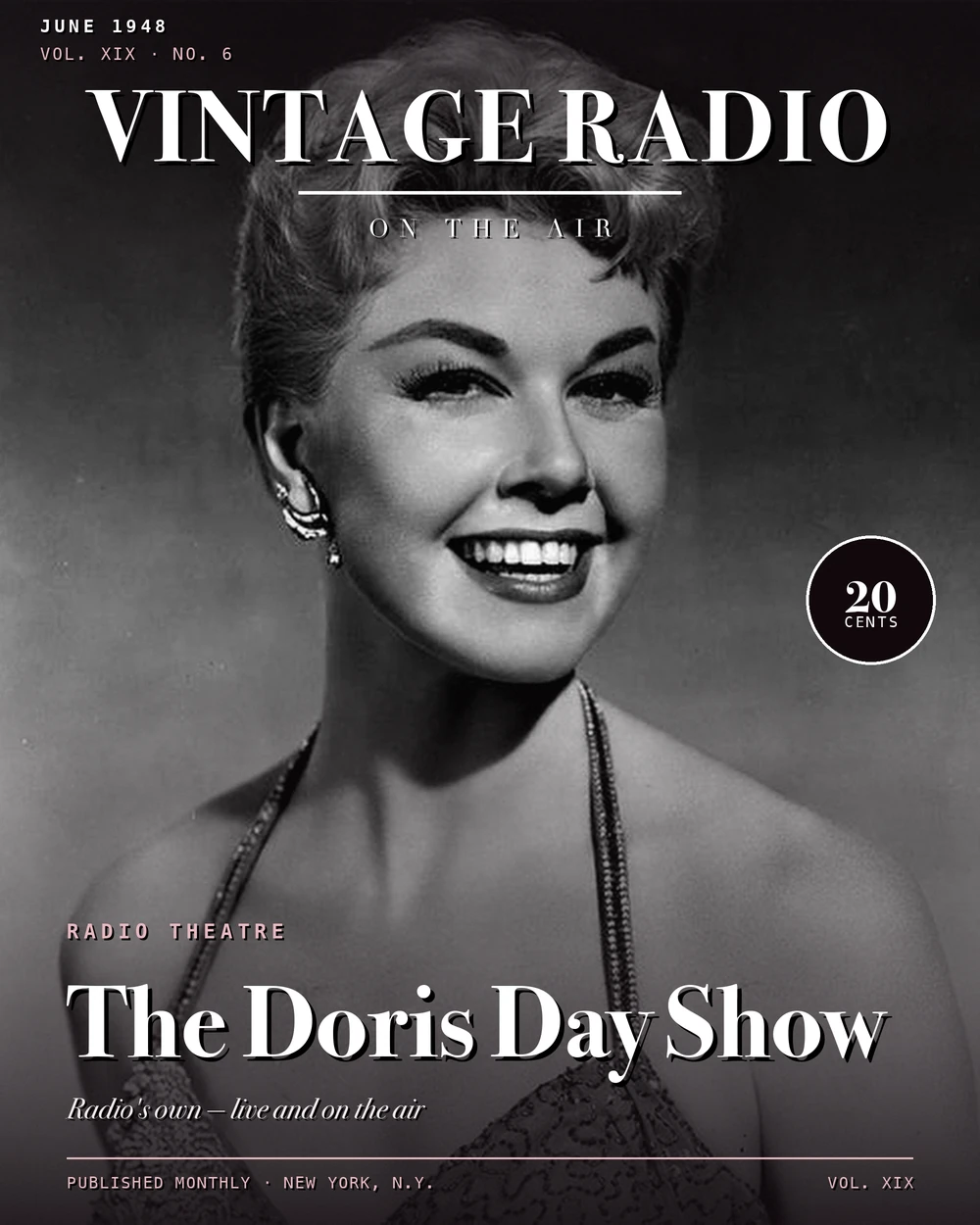
The Doris Day Show
What It Was
The Doris Day Show ran on CBS from March 28, 1952 to May 26, 1953 — a half-hour music series built around one of the era's most recognizable voices, with Les Brown and His Band of Renown providing the instrumental backing throughout. The show opened with "It's Magic," the song Day had introduced in her 1948 film debut Romance on the High Seas and ridden to number two on Billboard's Retail Record Sales chart that September. It closed with "Love to Be with You." Everything in between was transcribed in Hollywood in front of a live studio audience and preserved on 16-inch discs — a degree of polish that live broadcasts couldn't always guarantee, and which is part of why so much of the run still exists.
Each episode mixed Day's own Columbia Records catalog with live duets featuring the week's guest. She also cut roughly thirty songs specifically for the show with the Page Cavanaugh Trio and arranger Van Alexander. And in nearly every broadcast, she paused to remind listeners of troops serving abroad in Korea and elsewhere — a small, recurring grace note that gave the program a register beyond pure entertainment.
The Premiere and the Guest List
The opening broadcast on March 28, 1952 was tied directly to Day's recent film work. Her guests were Danny Thomas — her co-star in I'll See You in My Dreams, the 1952 biopic of songwriter Gus Kahn — and Mrs. Gus Kahn herself, the widow of the man whose life the film had dramatized. Thomas had played Kahn; Day had played his wife Grace; and now all three were in the studio together.
That set the template. Across the run, the guest chairs filled with an unusual mix of singers, film stars, and personalities: Gordon MacRae (the most frequent visitor, with at least four duets), Howard Keel, Kirk Douglas, Tony Martin, Ronald Reagan, George Murphy, Broderick Crawford, Frank Loesser, Ray Bolger, Liberace, Harry James, Van Johnson, Guy Mitchell, Dennis Day, Ray Noble, Bob Crosby, Mary Wickes, Jack Smith, and Jack Kirkwood. A June 1, 1952 episode put Day, Bob Crosby, and Ronald Reagan together on "Take Me Out to the Ball Game." Roy Rowan, Johnny Jacobs, and Don Wilson rotated through announcer duties; Sam Pierce directed and edited; Martin Nelson produced at least some episodes, with Fred Fox among the writers.
The Sponsorship Story
What looks on paper like a tidy fourteen-month run was, in practice, a series of sponsorship hand-offs that kept reshaping the show. Rexall picked it up first, as a summer replacement for Amos 'n' Andy, and stayed through the twenty-sixth installment. CBS-Columbia, Incorporated — the network's manufacturing subsidiary — then took over, using the show to promote a planned line of high-end television sets. That arrangement fell apart in January 1953 when CBS-Columbia's deal for a disused Mack Truck plant, intended for set manufacturing, collapsed. The program reverted to sustaining status through roughly March 24, then CBS restructured the remaining weeks: Louella Parsons took the first ten minutes of the old twenty-five-minute slot, and Day's portion shrank to fifteen. Nine episodes ran in that compressed format before the series ended on May 26, 1953. The total came to sixty broadcasts — fifty-one at twenty-five minutes, nine at fifteen.
There had been a chance for more. During the summer of 1952, Lever Brothers approached CBS and Day with a proposed twice-weekly fifteen-minute live production. Day turned it down to keep her schedule open for film work — a decision that reads, in hindsight, as the moment radio stopped being her future.
The Voice Itself
The people who worked closely with Day on her music tended to talk about her in the same terms. Sammy Cahn, who wrote the lyric to "It's Magic," said simply, "She gives a song everything it needs." Les Brown, who had known her vocal instincts since her band-singer days, put it this way: "I'd say that next to Sinatra, Doris is the best in the business on selling a lyric." Both compliments point at the same thing — phrasing, intelligence with the words, the ability to deliver a song so the meaning arrived intact. That quality is what the radio show was built to showcase, and what the surviving transcriptions still document.
Day had come to her own series with real radio experience behind her — vocalist spots on Sweeney and March in 1946 and The Bob Hope Show from 1948 to 1950. Her husband Martin Melcher, whom she had married in 1951, managed her career through the run.
After the CBS Run
The American broadcasts ended on May 26, 1953, but the recordings kept traveling. The Armed Forces Radio Network picked up the show and carried it across Europe through the end of August 1953, with augmented segments. Two years later, in 1955 and 1956, a version aired on the BBC with introductions by presenter Jean Metcalfe. Day herself chose not to pursue further radio work — Warner Bros. and the film career came first, and she was right about where the audience was going.
Decades later, in 2017, Joe Marchese compiled the first authorized release of her radio performances: Day Time on the Radio: Lost Radio Duets from the Doris Day Show (1952–1953), thirty-two tracks drawn from the surviving broadcasts — twenty-seven duets and five solos — with detailed liner notes and rare photographs. Day was born Doris Mary Anne Kappelhoff in Cincinnati on April 3, 1922, and lived until May 13, 2019. The radio series caught her at a specific and brief moment: already a film star, already a hit recording artist, and willing for fourteen months to spend half an hour a week singing into a microphone with whoever happened to be in town.